

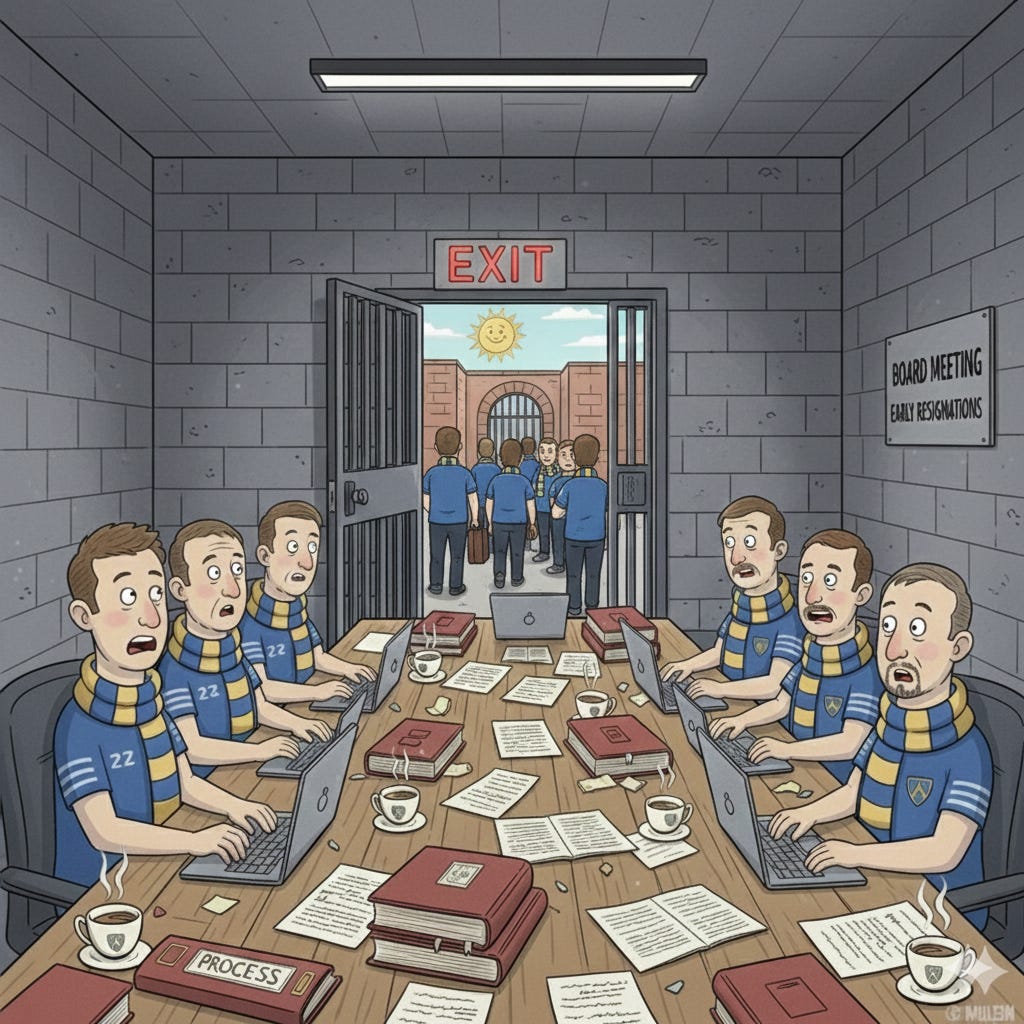
Ahead of the new Board being officially welcomed at the December AGM, we wanted to talk about term length.
Every year someone declares they’ve cracked the code. “Shorter terms will fix our problems.” and “Flexibility helps people stand.” It all sounds very community-minded until you read the minutes and see the same thing happening again and again.
The issue is not the length of terms. Whether one, two, or three years.
The issue is the number of people who do not complete them.
A DTB seat is not a hobby. Not a personal project. It is a governance role in a Trust that owns a football club.
And in the last three years, far too many people have treated it like something they can pick up and put down depending on mood, potential conflicts, or social media vibes.
A Board Built on Gaps, Not Continuity
Let’s be honest. We have had a run.
A run of early resignations.
A run of people stepping aside mid-cycle.
A run of members elected but unable to take their seats.
A run of co-options to plug holes that should not exist.
Across just three years we have seen:
Graham Stacey - resigning before the end of his term ahead of the 2022 election for 2023 Board Members due to “the DTB heading in a new direction”
Freddie Flaxman - resigning January 2023 to avoid “a potential conflict of interest”
Matt Lowndes - resigning in 2023, six months after elections because he didn’t feel he “could align his manifesto promises with the current communication issues”
Richard Shepherd, elected for 2 years in 2023 stepping down ahead of the 2024 elections due to “the role having a significant impact on his work/life balance”.
Ivor Hellor, elected for three years in 2024, resigned early “unable to take up his place on the board”. He offered to explain the reasons directly to anyone who asked. We have not, so we don’t know.
Sean McLaughlin, “resigned with immediate effect” mid-year in the 1st of his three years in 2025 as Chair of the DTB, a seat that he had campaigned so hard for. His unexpected early departure triggered reshuffles, handovers and inevitable co-options.
Ian Robinson departing “in response to the Board supporting the ESG”, leaving yet another vacant seat.
Simon Hood. The dramatic entrant. The dramatic exiter. The one who created the most noise and completed the least of what he stood for. He resigned from the Board in September “although remained as a candidate seeking re-election”.
Simon Hood (yes again), elected, unable to take up his place due to a “potential conflict of interest” (oh yes, that reason again).
We may have forgotten someone - if we have it’s not our fault, it’s hard to keep up.
Now some of these exits may have more validity than others. We are not here to judge each and every reason. Life happens. We understand.
But this is not membership churn. This is governance turbulence as it is in addition to the those coming to the end of their terms and not re standing or not getting re-elected.
And the Trust cannot operate properly when seats are treated like turnstiles.
The minutes themselves show how disruptive this has been.
March minutes note stalled GDPR work and risk assessments needing to be chased again because continuity had fallen apart again.
August minutes record yet another pair of co-options because earlier departures had left the board short-handed, plus the need to pay external help to rescue a constitution rewrite that had lost too many original contributors to finish internally.
The Women’s team strategy had to be re-explained at multiple meetings because the people working on it kept changing from one month to the next.
This is what happens when people leave early.
And it’s not because the term length is wrong.
When a Board Seat Becomes a Personal Stage
There is a particular type of board member who makes this worse.
We have all seen it.
They run on a crusading manifesto.
They talk about bravery. Transparency. “Speaking truth.”
They frame themselves as the lone defender of the people.
They fire shots from inside the boardroom.
They inflate disagreement into existential threat.
Then they quit.
Leaving the rest of the board to rebuild.
Leaving volunteers bruised.
Leaving working groups understaffed.
Leaving the Trust with another vacancy to fill.
They leave a trail of noise, not a record of service.
And because they didn’t stay long enough to finish anything, their only legacy is the disruption they caused on the way out.
Fan Commentary
WUP posters refer to “the DTB churn league table” and openly rank who lasted and who flounced.
Wombles Co-efficient track the all important xM stat, expected meeting contribution. They’re looking at an extended deep dive analysis to try and understand why the stats suggest some Members have a minus xM stat.
Even the Same Old Wombles Podcast - the DTBs equivalent of the singing section in the South Stand - joke that the DTB has pioneered “flexible-term membership” where everyone chooses their own expiry date.
Supporter ownership depends on trust.
Trust depends on continuity.
Continuity depends on people actually serving the term they were elected to serve.
Closing Thoughts
We do not need shorter terms. Three-year terms are perfectly sensible.
They give structure.
They give stability.
They give time to learn the job before you start steering a football club.
What we need is simpler.
Fewer resignations.
Fewer theatrics.
Fewer people treating a governance seat like personal branding.
A DTB role is a responsibility. A commitment.
A service to the club you claim to love.
Finishing the term should be the minimum, not the exception.
WombleWorld
Still waiting for the moment Terry Skiverton volunteers to run “DTB Resilience Training”. The first rule: you cannot leave early.
Fan Commentary: WHAD would have an opinion. Maybe great, maybe not so much...but they'd definitely have one! It'd be fun to listen to, and probably involve selling the club.